

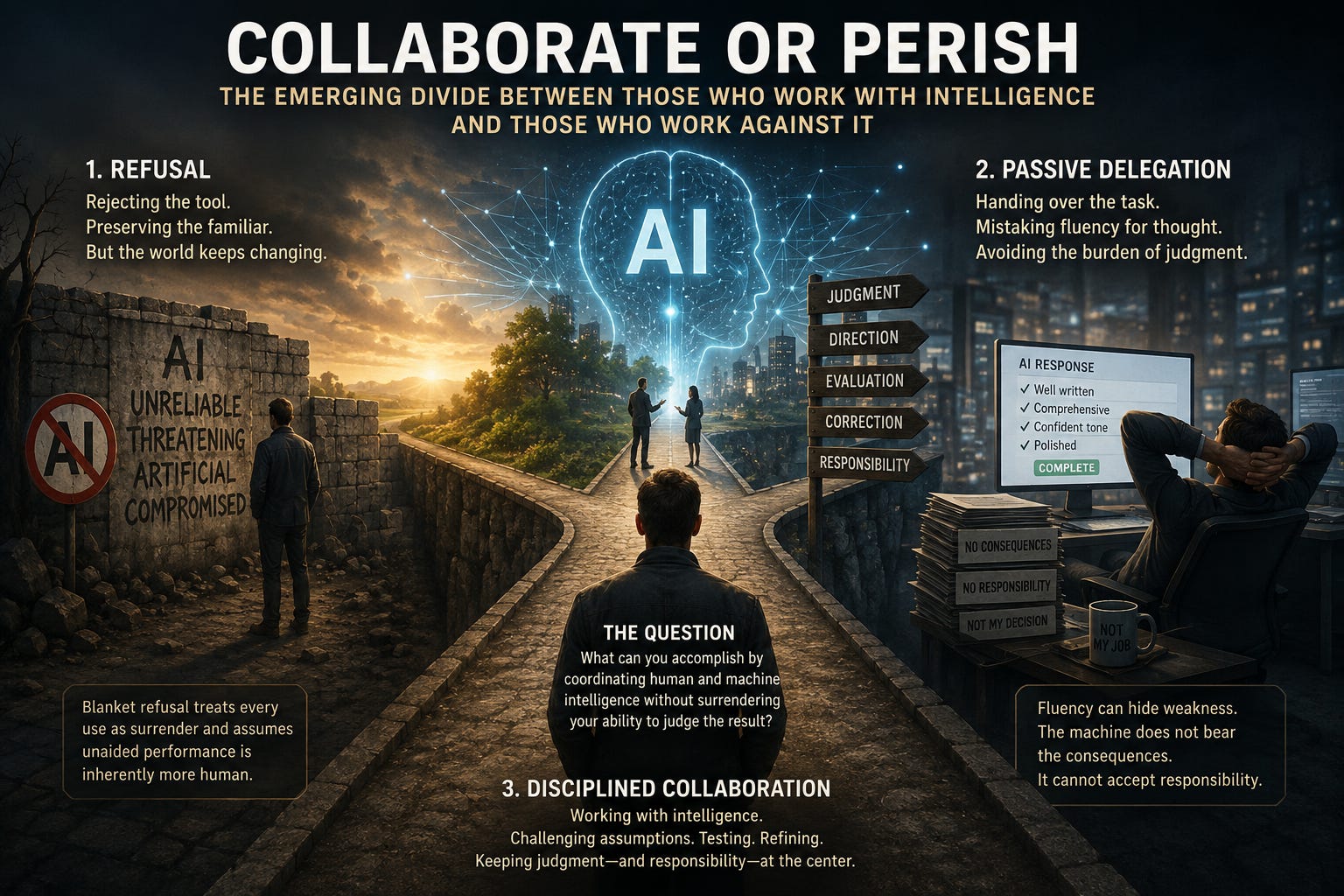
Most people know the phrase “publish or perish.” Even outside academia, the threat is easy to understand. Produce visible intellectual work or watch your relevance fade.
The phrase I want to test is just as blunt:
Collaborate or perish.
Taken literally, it is too dramatic. People who resist artificial intelligence will not simply disappear. But professions, institutions, and familiar definitions of competence can become irrelevant long before the people attached to them do.
That is the seriousness behind the phrase. Intelligence is becoming abundant. Refusing to learn how to work with it means continuing to compete under rules that are already changing.
Still, the emerging divide will not be between people who use AI and people who do not. That distinction is too shallow. Companies will buy licenses. Schools will hold workshops. Professionals will paste generated language into familiar documents and call the process innovation. The machinery will be new while the habits of thought remain untouched.
Use Is Not Collaboration
Adoption installs a tool. Collaboration changes the work. A collaborator has to decide what problem is worth solving, which parts of the work can be delegated, which claims need to be checked, where the machine’s reasoning is weak, and whether the final result deserves to exist.
Prompting is the most visible part of this process, and probably the least important. The harder skill is judgment under conditions of intellectual abundance.
For most of modern life, competence has been treated as an individual possession. What do you know? What can you produce? How quickly can you solve the problem on your own?
Those questions still matter. Foundational domain knowledge still matters because a person cannot reliably supervise a system capable of saying almost anything fluently without understanding the subject. But individual ability is becoming one part of a larger capacity.
The better question is this:
What can you accomplish by coordinating human and machine intelligence without surrendering your ability to judge the result?
That is a harder standard than ordinary AI use. It requires direction, evaluation, correction, and responsibility.
Research is beginning to show why. In a preregistered experiment involving 758 consultants, people using AI completed 12.2 percent more tasks and worked 25.1 percent faster on tasks within the system’s capabilities. On a complex task outside that frontier, however, AI users were 19 percentage points less likely to reach the correct answer. The same tool that improved performance in one part of the work helped conceal failure in another. The researchers called this the “jagged technological frontier” (Dell’Acqua et al., 2026).
Competence now includes learning where that frontier lies.
Three responses to this standard are taking shape.
The first is refusal. AI is unreliable, threatening, artificial, or morally compromised, so serious people should keep their distance.
Some caution is warranted. The National Institute of Standards and Technology documents risks involving confabulation, data privacy, harmful bias and homogenization, and human overreliance on generative AI. These systems can expose private information, reproduce prejudice, and encourage people to trust fluent answers more than they should (Autio et al., 2024).
But blanket refusal eventually becomes its own failure of judgment. It treats every use as surrender and assumes unaided performance is inherently more human. Preserving a familiar method is not the same as preserving human dignity.
The second response is passive delegation. A person hands over the task, receives what appears to be a polished response, and mistakes fluent language for a completed thought.
The danger is easy to miss precisely because these systems are capable. They can compare arguments, expose distinctions, reorganize material, and carry an idea toward finished form. They can also follow a bad premise with impressive efficiency. They flatten important ambiguities, invent plausible support, and create the sensation of understanding without its substance. Fluency can hide weakness remarkably well.
The machine also does not bear the consequences. It does not lose the job, mislead the student, damage the relationship, sign the report, or live with the decision. It can assist with judgment. It cannot accept responsibility on a person’s behalf.
In my own writing with AI, even when I have primed the system carefully, I still have to revise its output extensively. Very little of an initial response has lasting value verbatim. Most of it needs to be modified or discarded. Yet that initial response can open useful paths for thought, revealing distinctions, counterarguments, and possibilities that I can test.
The machine can generate alternatives quickly, but selection still requires a person who knows what the work is trying to say and is willing to reject shallow or bland language.
That willingness is part of disciplined collaboration. The machine, used correctly, can challenge assumptions rather than confirm them. Competing explanations are compared. Sources are checked. Convenient answers receive more scrutiny, not less.
This kind of oversight is not optional. In a 2025 study based on 936 examples from 319 knowledge workers, greater confidence in AI was associated with less self-reported critical-thinking effort. The researchers also found that AI shifted the work of critical thought toward verification, integration, and stewardship. Those are not secondary skills. They are becoming part of the work itself (Lee et al., 2025).
A determined refusal to use AI in any way and complete surrender to its production may look like opposites, but both commit the same sin. They avoid the difficult work of relationships. One rejects artificial intelligence because it is artificial. The other submits because it is impressive. Disciplined collaboration has to remain open to the machine’s contribution while continuing to test it.
What Happens to the Person?
Education is where this distinction becomes urgent. Schools have traditionally treated the submitted artifact as evidence of the student’s mind. The essay, solution, presentation, or project was supposed to show what the student understood. Generative AI weakens that connection. A student can now produce work that displays abilities the student has not developed.
Prohibition and surveillance are understandable responses. They are not an educational philosophy.
Education has at least two products: the work produced and the person formed while producing it. AI may improve the first while weakening the second. A cleaner essay does not prove that a student has become a better writer. A correct solution does not prove mathematical understanding. When a tool removes the struggle through which judgment develops, the artifact may improve while the learner becomes less capable.
That danger has now been measured. In a randomized study of nearly one thousand high school mathematics students, access to an unrestricted GPT-4 tutor improved performance during practice by 48 percent. When the tool was removed, those students performed 17 percent worse than students who had never used it. A version designed with teacher-created safeguards largely mitigated the damage. The researchers concluded that generative AI can improve immediate performance while inhibiting learning when appropriate guardrails are absent (Bastani et al., 2025).
The reverse is also possible. A student can use AI to test an argument, encounter objections, compare interpretations, find missing evidence, and revise with greater care. In that process, the tool can strengthen both the work and the learner. The important question is what happened to the student’s thinking.
A World Bank randomized trial in Nigeria offers a useful counterexample. A six-week program combining AI tutoring with structured prompts, teacher guidance, and reflection produced gains of 0.31 standard deviations across English, AI knowledge, and digital skills. English scores increased by approximately 0.24 standard deviations. The study cannot isolate the chatbot from the rest of the program, but that limitation reveals something important. The positive result came from AI embedded within a deliberately designed learning relationship, not from access alone (De Simone et al., 2025).
That means some work should remain deliberately unassisted. Memory, fluency, first attempts, sustained reading, live discussion, and the frustration of not immediately knowing are not obsolete inefficiencies. Sometimes the resistance is the curriculum. Anyone teaching collaboration must also teach when the student should work alone.
Assessment must move beyond asking whether AI was used. We need to ask what the student asked it to do, what was rejected, how its claims were verified, where the student’s view changed, and what the student can now explain without the tool. We also need to ask who owns the final judgment.
Authorship can no longer be defined by the absence of assistance. It must be demonstrated through ownership of the work. That standard asks schools to preserve evidence of thought while teaching students to use assistance honestly.
That responsibility does not belong to individuals alone. If collaboration with AI becomes a condition of professional participation, schools and employers owe people more than access. They owe them training, safeguards, time for verification, and a voice in deciding which decisions and responsibilities must remain human. Without those commitments, “collaborate or perish” becomes less a description of emerging competence than a threat imposed by institutions.
What Competence Now Requires
The emerging divide runs through every profession and every institution. It separates those who can work with multiple forms of intelligence while preserving judgment from those who either refuse the relationship or disappear inside it.
Disciplined collaboration will change us. It should. A genuine collaborator exposes weak assumptions, unsettles easy answers, and sometimes makes the work harder by revealing what we would rather leave unexamined.
The price is personal as well as institutional. We will have to surrender some speed for verification, some convenience for understanding, and some polished output for the slower development of abilities that remain when the tool is gone.
Competence is becoming collaborative, and the old idea that it belongs to the isolated performer producing answers alone may finally disappear. More of our meaningful work will emerge through collaboration between human beings and machines. What this requires is the ability to use AI’s strengths without submitting to its weaknesses while retaining judgment and responsibility for what the collaboration produces.
Sources and References
Autio, C., Schwartz, R., Dunietz, J., Jain, S., Stanley, M., Tabassi, E., Hall, P., & Roberts, K. (2024). Artificial Intelligence Risk Management Framework: Generative Artificial Intelligence Profile (NIST AI 600-1). National Institute of Standards and Technology.
Bastani, H., Bastani, O., Sungu, A., Ge, H., Kabakcı, Ö., & Mariman, R. (2025). Generative AI without guardrails can harm learning: Evidence from high school mathematics. Proceedings of the National Academy of Sciences, 122(26), e2422633122.
De Simone, M. E., Tiberti, F. H., Barron Rodriguez, M. R., Manolio, F. A., Mosuro, W., & Dikoru, E. J. (2025). From chalkboards to chatbots: Evaluating the impact of generative AI on learning outcomes in Nigeria (Policy Research Working Paper No. 11125). World Bank.
Dell’Acqua, F., McFowland, E., III, Mollick, E., Lifshitz, H., Kellogg, K. C., Rajendran, S., Krayer, L., Candelon, F., & Lakhani, K. R. (2026). Navigating the jagged technological frontier: Field experimental evidence of the effects of artificial intelligence on knowledge worker productivity and quality. Organization Science, 37(2), 403–423.
Lee, H.-P., Sarkar, A., Tankelevitch, L., Drosos, I., Rintel, S., Banks, R., & Wilson, N. (2025). The impact of generative AI on critical thinking: Self-reported reductions in cognitive effort and confidence effects from a survey of knowledge workers. In Proceedings of the 2025 CHI Conference on Human Factors in Computing Systems (Article 1121, pp. 1–22). Association for Computing Machinery.