
Plugging in Plain Language
Building apps in the age of age of language models.

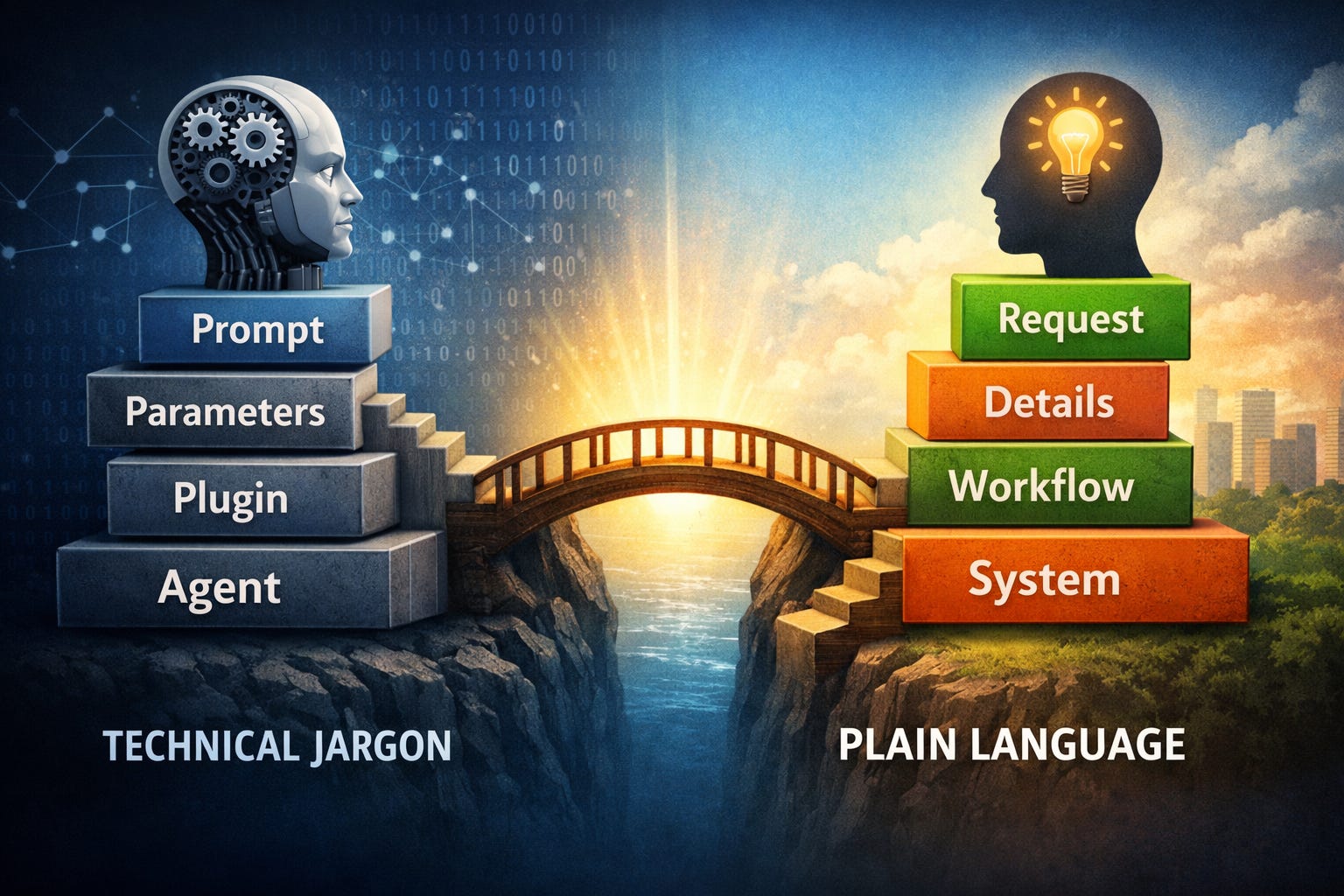
In my last essay, From Prompt to Plugin, I argued that many of the ideas behind modern AI systems sound more complicated than they really are. The difficulty often comes from the language used to describe them.
Engineering culture has a habit of creating specialized vocabulary for ideas that are actually quite simple. Words like prompt, parameter, constraint, plugin, and agent can make a process sound mysterious or technical. Yet when you look closely, most of these terms describe things people already understand in everyday life.
The real shift from prompt to plugin is not primarily technical. It is linguistic. Once the language becomes clear, the system becomes easier to understand.
Consider the word prompt. In the AI world, it refers to the instructions you give the system. But outside the engineering world, we already have many ordinary words that mean the same thing. A prompt is simply a request. It is asking for help with something.
If you say, “Write a summary of this article,” you are giving a prompt. But you are also making a request. The specialized term adds precision in a technical environment, but it does not change the basic idea.
The same thing happens with the word parameter. Engineers use this word to describe variables that influence how a task should be performed. In ordinary language, we would call them conditions or details.
If someone asks you to plan a dinner, they might add a few conditions:
One person is a vegetarian.
Another has an allergy.
There is a budget to respect.
In engineering language, they might be called parameters or constraints. In everyday language, they are just the circumstances that need to be considered.
The Translation Exercise
Seen this way, much of the specialized vocabulary surrounding AI becomes a translation exercise. This is why the transition from computer programs to AI is simpler when expressed in a common language:
A prompt is simply a request.
A task is a request that you expect to repeat.
A workflow is a sequence of tasks that work together.
A plugin is a workflow organized so it can run automatically.
None of these ideas requires advanced engineering knowledge. They describe a process of organizing instructions so that useful work can be repeated.
From Request to Skill
Imagine frequently asking an AI system to summarize articles. At first, you might type a request each time you need help: “Please summarize this article in five bullet points.”
After repeating this process several times, you realize the request rarely changes. So instead of rewriting it, you write a simple instruction file:
Summarize the following article.
Limit the result to five bullet points.
Focus on the main argument and key supporting ideas.
Now the request (prompt) has become a task (skill). It can be reused whenever it is needed. If you later add a second task—such as generating discussion questions based on that summary—the two tasks together form a workflow.
In engineering language, this might eventually be packaged as a “tool” or “plugin,” but at its core, it is simply a set of organized instructions.
Often, the complexity is not in the idea itself but in the language used to describe it.
For decades, interacting with computers required specialized languages. Precision was necessary because computers could not interpret ordinary language reliably. AI is changing that relationship. Systems can now interpret instructions written in everyday language with increasing accuracy.
This does not eliminate the need for engineers, but it does expand the number of people who can design useful tools.
The New Interface
This suggests that the most important skill may not be learning new technical vocabulary. It may be learning how to describe tasks and workflows clearly in ordinary language.
Instead of symbols and syntax, the program is written in sentences.
Instead of variables and functions, it contains conditions and steps.
Instead of debugging software, the author refines the wording.
The innovation is that machines can increasingly execute instructions written in the same language people use to describe everyday activities. Natural language becomes the bridge between human thinking and machine execution.
Once that bridge is recognized, the path from prompt to plugin becomes clear:
You begin with a request.
You refine it into a repeatable task.
You connect several tasks into a workflow.
Eventually, the workflow becomes a tool.
The entire process can be described without specialized jargon. And that may be the most important lesson of all: When the language becomes clear, the systems themselves become easier to plan and build.