
The Human Operating System
Toward Human Voice Proximity in AI Collaboration

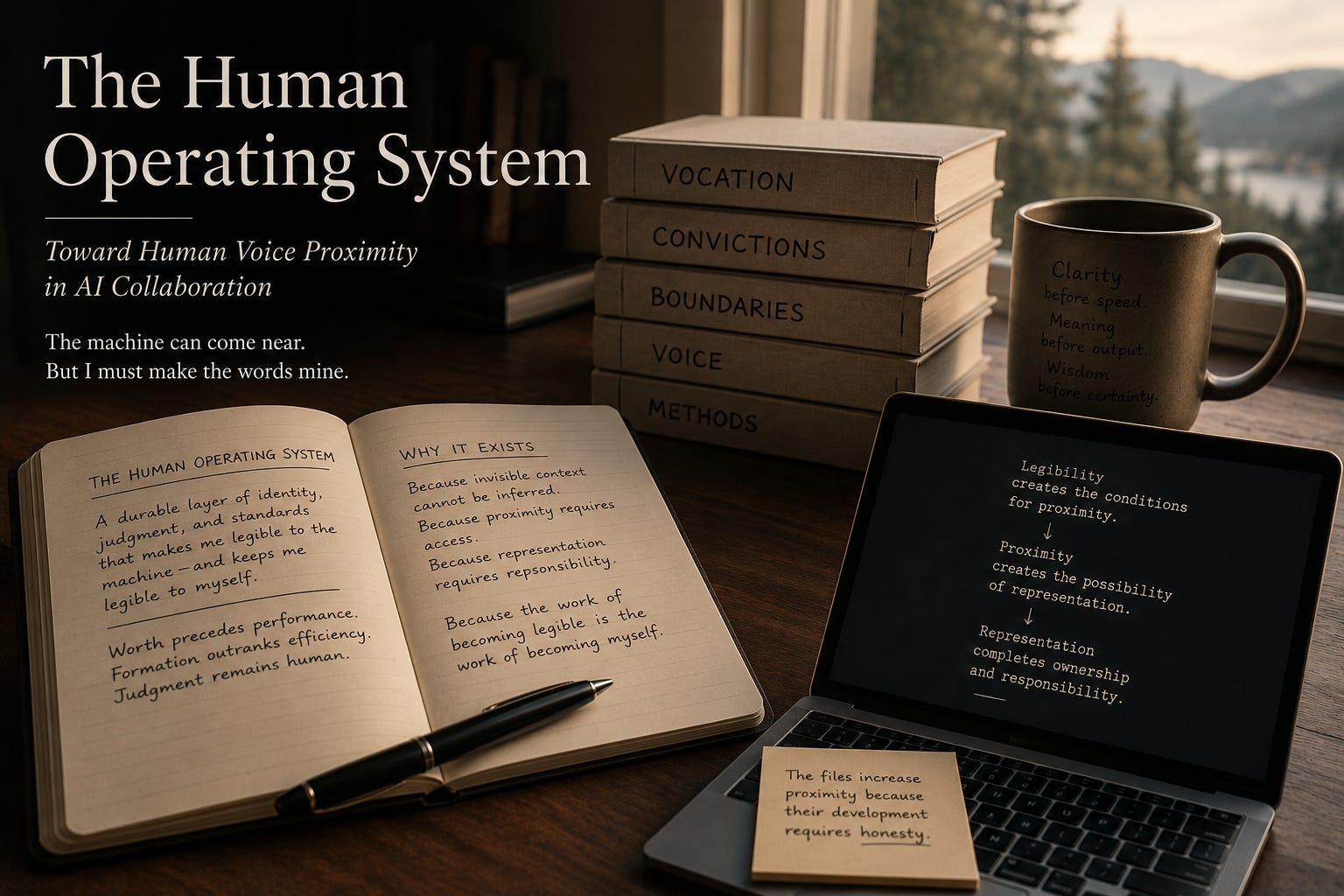
By Tim Moon. Reading Time: ~5 minutes
Behind the blinking cursor sits a folder of plain, carefully developed text files. Vocation. Convictions. Boundaries. Voice. Each holding part of me. And each allowing the machine access to what it otherwise could not see: My mission, my most critical beliefs, the lines I refuse to cross. And how I genuinely sound when the words are truly mine.
The machine can read those files in seconds, but the writing and development, which I had to labor over, took days. Not because of the number of words required, but because of the precision they demanded. I had to build foundational files of identity for the machine to wrap itself around to approximate me.
This required digging convictions out of instinct, and testing each for accuracy. Removing the appearance of wisdom without its weight. I had to decide where help becomes interference, where ease deforms, and where a useful tool asks too much in return.
It meant turning what I carried silently into words another intelligence could find. Only then could the machine, after careful brainstorming and dialogue, create something roughly approximating me.
Agent Legibility
I came across a name for part of this while reading OpenAI’s essay, “Harness Engineering: Leveraging Codex in an Agent-First World.” OpenAI’s engineers were building software with Codex agents. Their early problem was an underspecified environment. The agents could write code, but they could not use knowledge, inspect behavior, follow boundaries, or correct failure unless those things were made available to them.
So the engineers changed the environment:
They made the application visible.
They exposed logs and tests.
They placed knowledge in durable, structured documents.
They used a short file as a map into deeper sources rather than cramming every instruction into one swollen manual.
They called the goal agent legibility.
The phrase stayed with me.
Their subject was software. Mine is me, the human being working with the machine. The distance between those subjects matters. A repository can be mapped. A person transcends maps. Yet the same difficulty appears in both: one intelligence cannot work faithfully with context it cannot reach.
Human collaboration has always depended on invisible context. People can communicate context with eye contact and facial expressions and phrases. History, judgment, standards, memory, taste, and relationship make this possible. But AI cannot access this context.
AI did not create the need for legibility. It revealed how much of our work depended upon invisible context.
This matters even more as frontier models improve. The durable advantage of clever prompting is diminishing. But a person who has made his judgment, methods, and standards visibly present for the model provides a consistent, durable starting place—a structure that prevents continuous reconstruction for new conversations. Whatever remains sealed in my head may guide me; it cannot guide the machine.
The Durable Layer
Prompts offer temporary relief. I can pack more explanation into the box, add rules, paste examples, and try again. Tomorrow the box is empty. The work begins with another compressed account of who I am and what I mean.
I got tired of having to explain myself from scratch every morning.
Durable context changes this.
My Human Operating System separates what changes slowly from what will soon rot:
Layer I: The Durable Layer (Vocation, Convictions, Boundaries) — Changes very slowly, surviving the transition of models and years.
Layer II: The Developmental Layer (Voice, Method) — Evolves alongside personal craft and skill.
Layer III: The Passing Memory (Current Projects, Handoffs) — Transitory, perishable, and rewritten freely.
A new model may arrive next year. But the files remain plain enough to travel, making the system model-agnostic.
The model changes. The files do not. And the files provide legibility.
Proximity vs. Authenticity
Legibility does not mean perfect knowledge or memory; it merely creates the conditions for proximity.
Proximity is not certainty. It does not perfect a draft. It does not ensure the language perfectly captures my voice. It asks a smaller question: How near did the machine come?
When the machine can read the files designed to capture me and my work, any draft I ask for gets closer to me, better capturing my sound, my habits, and my concerns. Nearness means closer to me. Proximity is not a solution; it is a step closer to the final product. It paves the way for me to perfect the path.
I must polish the draft to bring it closer to authenticity. It still requires cutting, rebuilding, restoring, and replacing.
The machine can approach a voice, but cannot perfectly capture it. But a machine armed with the knowledge of me can legibly approximate me—moving the stones closer to their final setting.
Refining representation allows me to stand inside the work. It completes ownership. Stamp my name on it, a label of responsibility.
That ownership extends beyond style. Representation is moral ownership. I answer for the reasoning, the evidence I selected or ignored, the claims I left out, and the consequences of what I ask the reader to believe or do. A sentence may sound exactly like me and still fail to represent me.
Voice is resemblance.
Representation is responsibility.
This is where legibility turns back on the person who seeks it. The Operating System teaches the machine who I am, which I must first accurately identify. The files increase proximity because their development requires honesty.
The Shadow of Legibility
This is also where the argument can go wrong. Legibility has a shadow. Schools, governments, and organizations can make people legible so they can be more easily sorted, measured, predicted, and controlled. A life reduced to fields becomes easier to process and harder to see.
The demand for complete legibility would turn a person into a profile built for the convenience of a system. But that price is too high.
Human legibility must remain chosen, partial, and bound to a purpose. The files serve the person. The person does not owe the machine an exhaustive account of himself. Privacy protects more than information. It protects the unfinished, the sacred, and the parts of a life that lose something when forced too soon into words.
The Human Operating System begins from ground deeper than productivity.
Worth precedes performance.
Formation outranks efficiency.
Judgment remains human.
These convictions govern the use of the system because the system cannot govern them.
The cursor still blinks. The folder cannot contain the person sitting before it. It can preserve what he has learned to say, what he has chosen to protect, and where he intends to stand.
The machine can come near.
But I must make the words mine.