
A Digital Scarlet Letter
A strange thing to call transparency.

A Digital Scarlet Letter
On August 14, Anthropic published a measured explanation of its intent to watermark its text. It was a response to the angry questions following its recent watermark revelations. The answers were careful.
The watermark adds no hidden characters.
It does not slow the model down or increase its cost. It cannot be traced to a person, an organization, or a chat.
It does not change who owns the words. It only answers, with a probability, whether Claude was involved.
I believe them. That is what worries me.
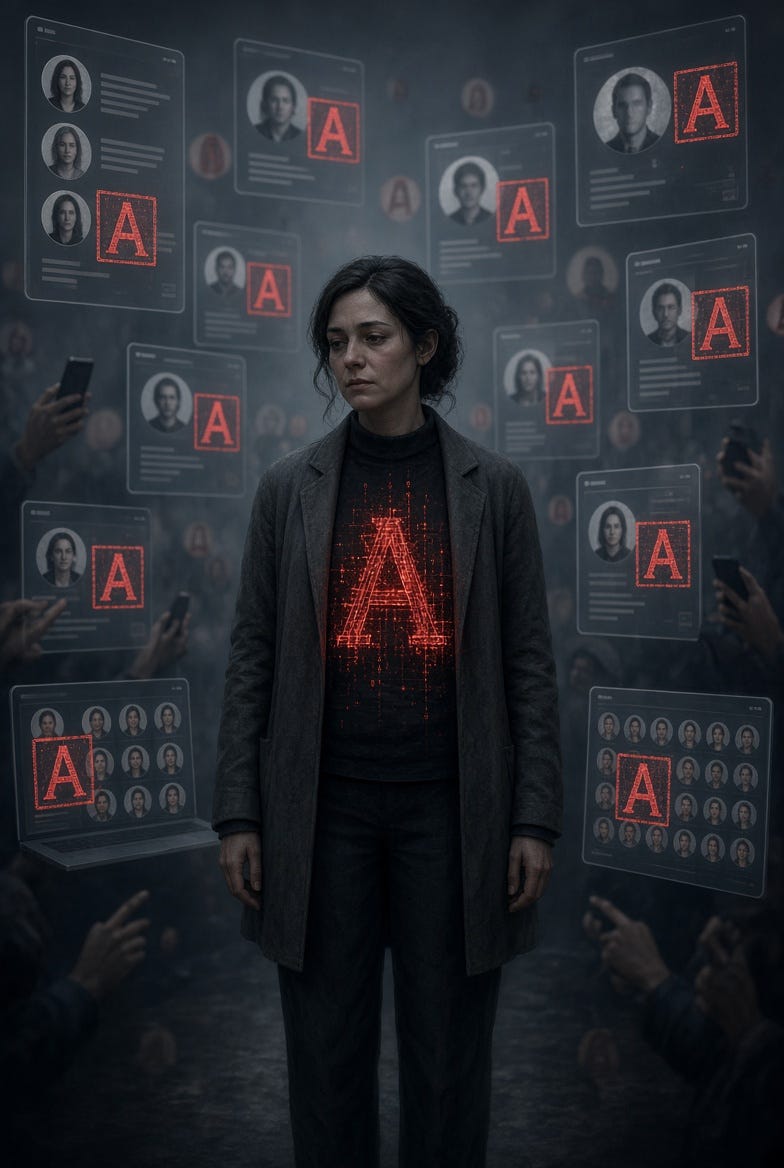
In the novel The Scarlet Letter, Hester Prynne is forced to wear an “A”. The letter provides no evidence; it does not say what happened, with whom, or why. It only says that this person is now the kind of person we punish. The town or community supplies the rest. That is what a scarlet letter is. It is not evidence of the act. It is a one-character summary of the act.
A mark that seems harmless in a lab but proves otherwise once it leaves. The question is not whether Anthropic is telling the truth about the technique. The question is how it will be viewed by the general public and used by institutions. A town’s actual use of the Mark matters.
Claude is a large language model that generates text by predicting the next word. Its watermark will be embedded in choices between equally plausible alternatives, like gray and overcast. Either works, but the machine’s choice leaves subtle footprints. The watermark changes the source of those selections, not the text’s meaning. Anthropic compares it to playing Monopoly using digits of pi instead of rolling dice: the game unfolds normally, but someone in possession of the key can identify a hidden sequence in the moves.
The method is elegant, and it is still only a whisper. A detector can only say Claude was likely involved. It cannot say Claude wrote the piece. It cannot say a student cheated. It cannot tell a light proofread from a full ghostwrite. Short passages barely register. A hard rewrite can wash the mark out. A translation carries it, because Claude will choose each word.
Anthropic openly admits this.
They will also ship a detection API. That is the part that does not stay in the lab. A whisper only Anthropic can hear is a research method. But a whisper that publishers, platforms, schools, and employers can see becomes a sorting rule.
Three days before Anthropic’s explainer appeared, I published Collaborate or Perish, claiming authorship can no longer be defined by the absence of assistance. Instead, it must be shown through ownership of the work. I also outlined how I use these tools as an author.
That essay was an argument for machine-human collaboration in the creation process. A proactive path toward the future.
It also provided a record of such a collaboration. If a detector later flags it, the flag will be technically true and still almost useless. It will not tell you what I kept, what I threw away, or whether I can carefully explain the argument with the tool closed.
I openly and unashamedly practice AI collaboration in my writing. I prime the system carefully through prompting, adding context, iteration, and discussion. I use it to help pave the way in an argument. The initial product always requires extensive revision. Very little of a first response has lasting value as it stands. Most of it gets changed or thrown away. But what blossoms from the collaboration is real, dynamic, and human.
Here is what I fear will result from this misguided policy by Anthropic. The people most likely to wear this Scarlet Watermark will not be the people most determined to deceive. A student who pastes a whole essay and never looks back can evade detection by running the text through another model and stripping the mark. A writer who asks Claude to tighten a paragraph, or a teacher who asks it to help think through a lesson, will innocently and unknowingly leave the letter on the page.
Casual honesty will get tattooed, while determined evasion will get a bath.
Anthropic will no doubt be comforted by the fact that light editing may not leave enough signal to detect. A complete rewrite, they say, is arguably no longer AI-generated. But then the mark is not a record of involvement. It is a record of involvement that was not carefully hidden.
That is a strange thing to call transparency.
I do not think Anthropic intends for this result. I think they intend to comply with the European Union’s new rules on marking AI-generated content, and they applied the mark worldwide because they could not yet confine it to Europe. Other companies signed the same code. Google has been watermarking images for years. OpenAI had developed text watermarking years earlier but declined to deploy it, partly because users said it would make them less likely to use ChatGPT.
That last fact is worth carefully considering. If the mark were only a technical courtesy, nobody would lose a customer over it. People leave when a tool starts talking about them behind their back.
The watermark will not be satisfied with probability. Software does not hold seminars on European statutes. It sorts creators. A newsletter platform will want a cheap way to flag AI. A hiring office will want a cheap way to discard a cover letter. A journal will want a cheap way to police a no-AI rule. Some of those uses have a point.
But used arbitrarily, it will also tag honest collaborators. And it will treat them as the same, because one bit cannot tell them apart.
If we accept that bit as a moral rule used to qualify and sort, we give up the harder work I called for in my essay. We will stop asking what someone asked the tool to do, what they threw away, and what they can carefully explain without the machine. We will let a machine-readable suspicion stand in for a person. That may be efficient, but hardly just.
We should be looking for the evidence of the person, not the evidence of the machine.
That is the honest remedy.
If a school, a journal, or a platform uses its own watermarks, fine; that is their prerogative. But unless the honest next move is to ask qualifying questions, it will be treating the symptom, not the cause, and detecting the honest, not the violators.
But it is not the job of Anthropic to provide a blanket tool that can be used to justify careless accusations.
Hester’s town had a Scarlet Letter. What it lacked was a useful narrative of the person forced to wear it. We are about to be handed a digital Scarlet Letter that we can apply at scale.
To avoid using this Scarlet Watermark as a verdict, publishers, platforms, and readers have to do the work of critical thinking and reading at scale.
The cost of accepting it as a verdict is nothing but a shortcut to fairness. Sit with that: a shortcut to fairness, to indict a writer taking a shortcut. Hmmm.
I will keep writing the way I have been writing. I will openly celebrate the machine in the room, yet continue to dispense with most of what it generates. If that leaves a mark on the page, so be it. I guarantee there will also be a writer on the page, if you care to look.
If this touches a nerve, let’s talk sometime. timsmoon@gmail.com / (757) 746-2931
Great article. Anthropic suddenly becomes the moral police after paying Billion Dollar settlements. Makes every well researched book cancelled.
Well reasoned analysis!